
PPF and ELSS are the two most popular options under section 80C, and the “which is better” question gets asked a million times a year. The honest answer is neither, they’re complementary, not competitive. If you’re forced to pick only one in 2026, the answer depends on your age, tax regime, and risk tolerance.
This article breaks down the math, the tax treatment, and the situations where each wins. The numbers come from the PPF calculator and the SIP calculator (for ELSS, which is structurally a SIP into an equity mutual fund).
Quick comparison
| Feature | PPF | ELSS |
|---|---|---|
| Lock-in | 15 years (extendable in 5-year blocks) | 3 years per instalment |
| Returns | 7.1% (notified, government-set) | 12-14% expected (market-linked) |
| Risk | Sovereign-guaranteed | Equity market risk |
| Annual cap | ₹1.5 lakh (statutory) | No cap (₹1.5L for 80C deduction) |
| Tax on returns | Fully tax-free (EEE status) | LTCG 12.5% above ₹1.25L/yr exemption |
| Liquidity post-lock | Annual partial withdrawal allowed | Fully liquid after 3 years per instalment |
| 80C eligible | Yes | Yes |
| Allowed under new tax regime | Investment is fine, but no 80C deduction | Same, investment is fine, no deduction |
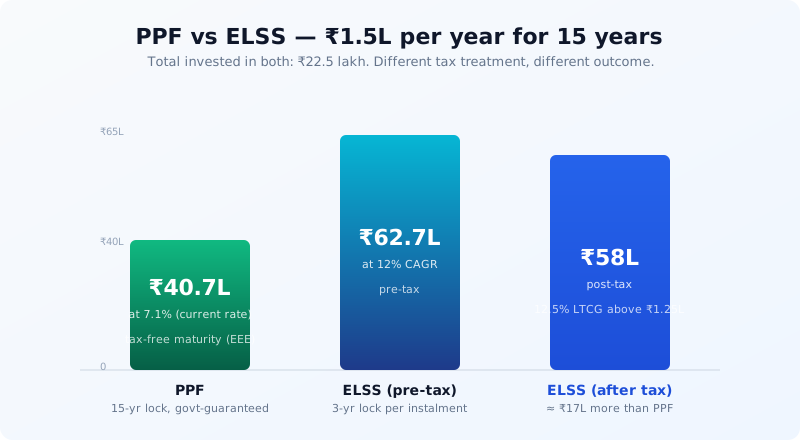
What ₹1.5 lakh becomes in each
Run ₹1.5 lakh per year for 15 years (the PPF lock-in period) through both:
| Investment | Total invested | Maturity (15 yrs) | Effective post-tax for 30% slab |
|---|---|---|---|
| PPF at 7.1% | ₹22,50,000 | ₹40,68,209 | ₹40,68,209 (tax-free) |
| ELSS at 12% CAGR | ₹22,50,000 | ₹62,71,099 | ₹57,98,861 (after 12.5% LTCG above ₹1.25L exemption) |
| ELSS at 14% CAGR | ₹22,50,000 | ₹74,30,012 | ₹68,29,386 (similar treatment) |
The post-tax ELSS at 12% CAGR is roughly ₹17 lakh more than PPF over 15 years on the same contributions. At 14% it’s ₹28 lakh more. The pre-tax CAGR of PPF is 7.1%, but its tax-equivalent CAGR for someone in the 30% slab is roughly 10.3%, still less than ELSS’s expected 12%.
So if both were guaranteed to deliver their advertised returns, ELSS would win cleanly. The question is whether ELSS’s 12% expectation will hold over your specific 15-year window, and that’s market-linked, not guaranteed.
What’s special about each
PPF’s three structural advantages
EEE tax status: contribution gets 80C deduction (under old regime), interest accumulates tax-free, maturity is tax-free. There’s nothing else in Indian tax law with this triple exemption other than EPF (above 5-year service) and Sukanya Samriddhi (for daughters under 10).
Sovereign guarantee + zero credit risk: PPF is backed by Government of India. Banks can fail, mutual funds can underperform, but PPF will pay. This is invisible most years and matters enormously in the 1 year out of 30 when something goes wrong.
Floor on rate: the political stickiness of small-savings rates means PPF rarely drops below 7%, even when bank FDs fall to 5%. The PPF rate has been 7.1% since April 2020, 5 years constant despite repo rate moves.
ELSS’s three structural advantages
Higher expected returns: 12-14% CAGR over 10+ year windows in Indian equity vs PPF’s 7.1%. Over 15 years that compounds into a 50-90% larger corpus depending on which CAGR you assume.
Shortest 80C lock-in: 3 years per instalment, the shortest of any 80C-qualifying option. After year 3, individual SIP instalments become liquid as they cross 3 years. By year 5 of an SIP, you have substantial accessible capital, useful for opportunistic re-allocation.
No annual cap on investment: PPF caps you at ₹1.5L/year by law. ELSS lets you invest as much as you want, but the 80C deduction is still capped at ₹1.5L. So ELSS scales beyond the deduction limit if you want pure equity exposure with the lock-in discipline.
When PPF clearly wins
Conservative investor with no equity tolerance. If a 30% drawdown would make you sell, you shouldn’t be in equity. PPF is the right call. Most retirees and parents-of-young-children investing in their own name fall here.
Last 5-7 years before a fixed goal. Equity volatility within 5 years is genuine sequence-of-returns risk. PPF (or equivalent debt) gives you predictable maturity. Don’t trust 12% CAGR over a 5-year window, Indian equity has had 5-year periods returning 6% (and worse).
Already heavy in equity elsewhere. If 80% of your portfolio is in equity SIPs, NPS Tier I (auto-equity), and ESOPs from your employer, PPF acts as the debt anchor. The 7.1% sovereign-guaranteed yield in your portfolio is exactly the diversification you need.
Low-discipline investor. PPF can’t be touched for 15 years. Tempted to sell mutual funds in every panic? PPF removes the option. The 15-year lock-in is a feature, not a bug.
When ELSS clearly wins
Long-horizon (15+ years) investor with stable income. The math is unambiguous over 15+ years. Equity at 12% beats debt at 7.1% by a lot. Young salaried people with 20-30 years to retirement should weight heavily toward ELSS.
You’ve already maxed PPF and need additional 80C. PPF’s ₹1.5L cap is the entire 80C cap. So once you’ve put ₹1.5L in PPF, you’ve used 80C. But if you’re using PPF only partially (say ₹50K) because of cash flow, ELSS for the remaining ₹1L of 80C makes sense.
You want some 80C savings to remain liquid after 3 years. ELSS is the only 80C option with 3-year lock-in. PPF is 15. Tax-saver FD is 5. NSC is 5. NPS is until 60. ELSS gives you the most flexibility post-lock.
You’re under the new tax regime and don’t need 80C. Then you don’t need ELSS for the deduction either. But the structural advantage of ELSS as a disciplined equity vehicle (3-year lock-in forces holding through volatility) still applies. Many investors continue ELSS even without claiming 80C.
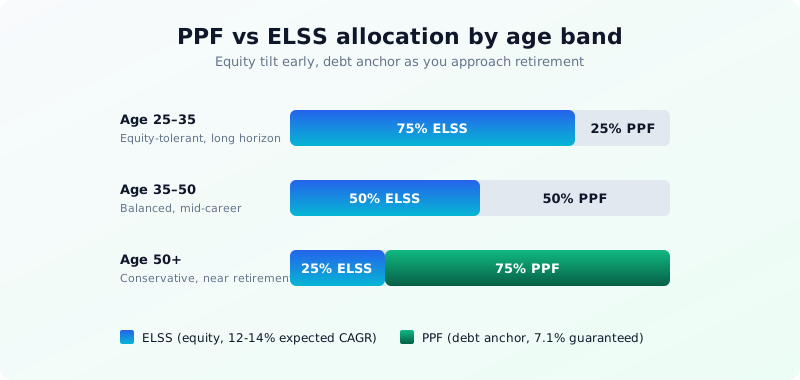
The realistic answer: do both
Most personal-finance advisors recommend splitting the 80C limit between PPF and ELSS in some ratio:
- Age 25-35, equity-tolerant: 70-80% ELSS, 20-30% PPF
- Age 35-50, balanced: 50-50 split is the textbook
- Age 50+, conservative: 70-80% PPF, 20-30% ELSS
Why split at all? Because ELSS’s expected return assumes the next 15 years roughly resemble the last 15. If they don’t (which has a non-trivial chance), PPF’s guaranteed 7.1% becomes the floor that prevents disaster. And vice-versa: if equity has a great decade, your ELSS portion captures it.
A sample split for someone at age 32 doing ₹1.5L of 80C:
- ₹1,00,000/year ELSS SIP (₹8,333/month, two funds maybe)
- ₹50,000/year PPF (deposit by April 5 to maximise interest)
Over 15 years at 12% ELSS / 7.1% PPF:
| Investment | Total invested | Year-15 value |
|---|---|---|
| ELSS portion | ₹15,00,000 | ₹41,80,733 |
| PPF portion | ₹7,50,000 | ₹13,56,070 |
| Combined | ₹22,50,000 | ₹55,36,803 |
That’s better than 100% PPF (₹40.7L) and more resilient than 100% ELSS, while still capturing most of equity’s upside. The “do both” answer is rarely the most exciting, but it’s usually the most useful.
What about the new tax regime?
Under the new regime (default from FY 2025-26), 80C deduction is not available. So:
- PPF: still earn 7.1% tax-free, just no 80C deduction. Still sensible if you want a guaranteed-return debt anchor.
- ELSS: still earn equity returns with 3-year lock-in, no 80C deduction. The lock-in becomes pointless for tax purposes, at that point you might as well buy a regular flexi-cap fund without the lock-in.
If you’re firmly on new regime and don’t claim 80C, drop ELSS for a flexi-cap fund. The flexi-cap has the same expected return without the artificial 3-year lock-in. ELSS only makes sense when you’re claiming 80C, otherwise it’s a flexi-cap with worse liquidity.
PPF remains useful regardless of regime because its actual return is tax-free. That’s a permanent advantage.
Common mistakes
1. Treating PPF as a one-time deposit. PPF compounds annually only on the contribution made, plus accumulated balance. Skipping a year means you lose that year’s compounding base. Set up an auto-debit on April 4 (before the 5th-of-month interest cutoff) for ₹1.5L every year.
2. Stopping ELSS SIP after 3 years. The 3-year lock-in is per instalment, not for the whole SIP. Stopping the SIP after 3 years means you stop accumulating. Continue the SIP for the full goal horizon (10-15 years); just know that each year’s instalments individually become withdrawable 3 years after they were paid.
3. Confusing ELSS with ULIPs. ULIPs (Unit-Linked Insurance Plans) also qualify for 80C, but they have 5-year lock-in, much higher charges (premium allocation, mortality, fund management, total ~3-5% per year), and lock you into a specific insurer. Most personal-finance advisors recommend ELSS over ULIPs for 80C investing. Buy a separate term insurance plan for life cover.
4. Putting tax-saver FD in 80C. Returns are taxable (so post-tax CAGR is ~5% at 30% slab), 5-year lock-in, no 80C-specific advantage. Strictly inferior to PPF for the same risk profile. Use only if you’ve maxed PPF.
How to start each
PPF:
- Open at any major bank or India Post. SBI YONO, ICICI iMobile, HDFC NetBanking all let you open online with Aadhaar+PAN+video KYC.
- Set standing instruction for ₹1.5L annual transfer on April 4 each year (one shot is more efficient than 12 monthly deposits because of the 5th-of-month interest cutoff).
- Accept the 15-year lock-in mentally, pretend the money doesn’t exist.
ELSS:
- Pick a fund: Mirae Asset ELSS Tax Saver, Quant ELSS Tax Saver, Parag Parikh ELSS Tax Saver, Axis Long Term Equity, ICICI Prudential Long Term Tax Saving, all reasonable choices in 2026 (look at 5-year and 10-year rolling CAGR, not 1-year)
- Use Groww, Kuvera, Coin, Paytm Money or directly through the AMC website. Direct plans only, they save 0.7-1% in expense ratio versus regular plans
- Set up monthly SIP auto-debit. Maxing 80C with ELSS means ₹12,500/month
- Continue through downturns. The 3-year lock-in helps you do this involuntarily
Frequently asked questions
Can I claim 80C if I do both PPF and ELSS?
Yes, 80C is a single ₹1.5L cap covering the sum of all eligible investments. PPF + ELSS contributions together can total up to ₹1.5L for the deduction. Anything above is invested but not deduction-eligible.
What about NPS Tier I in this comparison?
NPS Tier I has additional ₹50K deduction under 80CCD(1B), separate from 80C. It’s mandatory equity-debt mix (auto choice or active choice up to 75% equity), locked till retirement (60 years), and partly taxable at withdrawal. Use NPS for additional retirement savings beyond 80C, not as a 80C alternative.
Is the PPF rate going to drop?
Possibly. The PPF rate is anchored to the 10-year G-sec yield with a +25bps spread. As yields drop, the formula recommends a cut. But the government has politically held PPF at 7.1% since April 2020 despite formula recommendations to drop. The downside risk is moderate, maybe 6.5% in the next few years if rates drop further. Still attractive for tax-free.
Can I withdraw from PPF before 15 years?
Limited. Years 1-6: no withdrawal. Years 7-15: one partial withdrawal per year, up to 50% of balance at end of 4th preceding year. Premature closure (5-year minimum) is allowed only for serious illness, higher education, or NRI status change with a 1% penalty on entire interest paid.
Can I redeem ELSS before 3 years?
No, the 3-year lock-in is statutory, not optional. Redemption before 3 years is not permitted; you can’t “pay penalty” to exit early. Each instalment locks for 3 years individually.
Run your numbers
Use the PPF calculator to see what your annual PPF contribution becomes at the current 7.1% rate over 15-30 years (with extensions). Use the SIP calculator for ELSS projections at your assumed CAGR.
For the tax savings on the 80C portion (under old regime), the income tax calculator shows the actual rupee impact of claiming the deduction.
Sources
- Ministry of Finance: Public Provident Fund Scheme, 2019 + quarterly rate notifications
- Income Tax Act 1961: Sections 80C, 10(11), 112A (LTCG), 87A
- AMFI ELSS scheme database and 10-year rolling CAGR data
- SEBI Categorisation of Mutual Funds (October 2017): ELSS definition and lock-in
- Budget 2024: STCG and LTCG rate amendments