
My friend Rohit got a ₹3 lakh year-end bonus last December. First thing he messaged me: “bhai, SIP karu ya ek saath daal du?”
I’ve gotten this exact question maybe 40 times in the past two years. And every time I see some financial influencer say “always SIP for rupee cost averaging” I want to flip a table. Not because SIP is bad. But because that answer sidesteps the actual maths, and the actual maths tells a more complicated story.
So here it is, no fluff.
Lumpsum beats SIP most of the time. Yes, really.
Same ₹6 lakh. Same 12% CAGR assumption. 10 years.
| How you invested | What you end up with |
|---|---|
| Lumpsum on day 1 | ₹18,63,508 |
| SIP of ₹5,000/month × 120 months | ₹11,61,695 |
That’s a ₹7 lakh gap. On the same money. Same return rate. Same time period.

Why? Because in lumpsum, all ₹6 lakh is sitting in the market from day one, compounding for the full 10 years. In a SIP, the first instalment gets 10 years. But the last instalment, the ₹5,000 you put in in month 120, gets exactly one month. Average across all 120 instalments and the money has only been invested for about 5 years on average. Half the time of lumpsum.
This is the boring maths that nobody puts in a YouTube Reel. SIP isn’t mathematically superior. It’s actually mathematically inferior. The “SIP wins” narrative exists for other reasons, which I’ll get to.
Data point: researchers running rolling 10-year windows on Nifty 50 since 2000 found lumpsum beats SIP roughly 65% of the time. SIP wins in the other 35%, specifically in windows that started near a market peak and went through a deep crash.
Okay but most people can’t do lumpsum anyway
Here’s the thing Rohit’s situation and most people’s situation are completely different.
Rohit had ₹3 lakh sitting in his account. Most people investing in mutual funds don’t have a ₹6 lakh corpus ready to deploy. They have ₹10,000 or ₹20,000 from their monthly salary. The “lumpsum vs SIP” debate is genuinely irrelevant for them. You can’t lumpsum money you don’t have.
So if you’re investing from your monthly salary, stop reading the comparison articles. SIP is your only option. Not because it’s mathematically better but because there’s nothing else to compare it to.
The debate only matters if you’re sitting on actual cash. Bonus money. ESOP sale proceeds. Inherited amount. EPF withdrawal. Something chunky that showed up and now you need to decide what to do with it.
When lumpsum is obviously wrong
- Someone puts ₹10 lakh into the market in January. By March 2009 it’s worth ₹4.8 lakh. They’re down 52%. Yes they’ll recover, by 2014 they’re ahead of where they started. But the 18 months in between? Brutal. A lot of people sell at the bottom and never come back to equity.
Same person doing ₹8,333/month SIP from January 2008? Those 18 months of market crash were actually helpful, they kept buying cheaper units every month. Their average cost dropped. Recovery came faster.
This is what “rupee cost averaging” actually means in practice. It’s not a vague theoretical benefit. It’s specifically useful when markets fall after you start investing. Which you can’t predict.
So lumpsum has this single vulnerability: timing. If you put it in near a peak and markets crash shortly after, the psychological damage can make you do something stupid. SIP protects against that because there’s no single “entry point” to regret.
The STP middle path (most people ignore this)
Systematic Transfer Plan. Basically, park the whole lumpsum in a liquid fund today, then set an automatic monthly transfer into equity over the next 6-12 months.
Why this makes sense for large chunks:
- The undeployed money earns 6.5-7% in the liquid fund instead of 3% rotting in savings
- You enter equity gradually, so no single bad entry point to regret
- After setup it’s automatic, no decisions, no timing the market
- Most AMCs offer it free between funds in the same house (HDFC, ICICI, Mirae, SBI, Nippon all do this)
For amounts above ₹3 lakh, STP over 6-9 months is probably what a decent fee-only advisor would suggest. It gives you most of lumpsum’s mathematical edge while removing the psychological timing risk.
So what should Rohit do with his ₹3 lakh?
I told him: invest it as lumpsum into an index fund. Here’s why.
His goal is retirement, 28 years away. At that horizon, even if the market drops 40% in year 1, it gets washed out by what happens in years 20-28. The math on the lumpsum calculator makes this obvious, at 28 years and 12% CAGR, ₹3 lakh becomes ₹1.07 crore. Whether you entered at a 10% premium or 10% discount barely moves that number.
He’s also not the type to check his portfolio every day. When I asked “will you panic-sell if it drops to ₹2 lakh next year?” he said probably not. That matters. Lumpsum only really hurts you if you bail out during the drawdown.
If he’d said “yes I’d lose sleep over that”, then STP over 9 months. Same expected outcome, less anxiety.
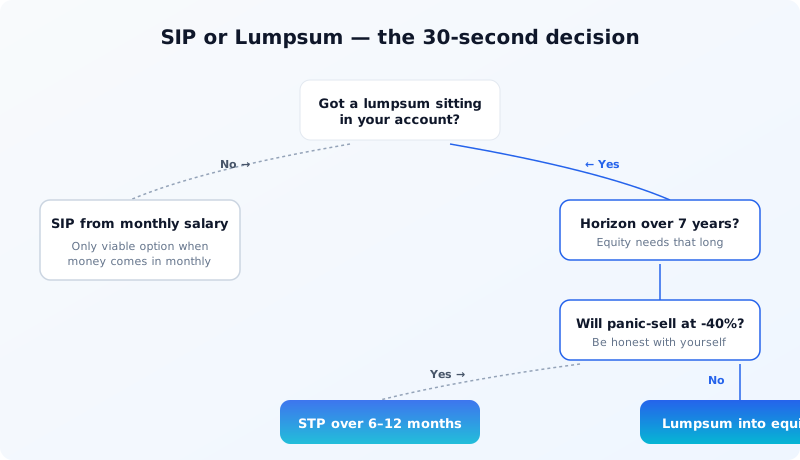
The actual decision rule (not the generic one)
Got a lumpsum. Horizon over 7 years. Won’t panic-sell during a crash. → Lumpsum into equity index or flexi-cap.
Got a lumpsum. Horizon over 7 years. Would probably lose sleep if it dropped 40%. → STP over 6-12 months. Park in liquid fund, transfer monthly.
Investing from monthly salary. No lump sum available. → SIP. Full stop. This comparison doesn’t apply to you.
Horizon under 5 years. Need the money for a specific goal. → Don’t put it in equity at all. Debt fund or FD.
Run the actual numbers for your situation in the SIP calculator and the lumpsum calculator. Same corpus, same return assumption, your actual number of years, you’ll see the gap in rupees for your specific case.
One more thing on return assumptions
I used 12% CAGR throughout. That’s a reasonable long-run assumption for Indian large-cap / index funds. Historically Nifty 50 has done about 12-13% over rolling 15-year windows.
But use the conservative end when planning. 11% for large-cap index, 13% if you’re comfortable with flexi-cap or mid-cap. If your financial plan only works at 18%, that’s a goal problem, not a calculator problem.
Quick reference on realistic expectations:
| What you’re in | Realistic 10-year CAGR |
|---|---|
| Nifty 50 / Sensex index | 11-12% |
| Flexi-cap / multi-cap | 12-14% |
| Mid-cap | 13-16% (with wilder swings) |
| Small-cap | 14-18% (steepest drawdowns too) |
| Liquid / ultra short debt | 6-7% |
Tax note before you decide
Equity mutual funds held over 1 year: LTCG taxed at 12.5% above ₹1.25 lakh annual exemption (Budget 2024 change). Under 1 year: STCG at 20%. Nothing complicated but worth knowing, especially for STP, where each monthly transfer into the equity fund starts its own 1-year holding clock.
Rohit did the lumpsum. Market’s up about 11% since December. He’s happy. But honestly it could just as easily have gone the other way in the first few months and he’d still have been fine given his 28-year horizon. That’s the point, for long horizons, the lumpsum vs SIP debate matters a lot less than just investing, consistently, without touching it.
The SIP calculator and lumpsum calculator on Calxo both use the standard compound interest formula, plug in your numbers and see what the gap actually looks like for your situation.