
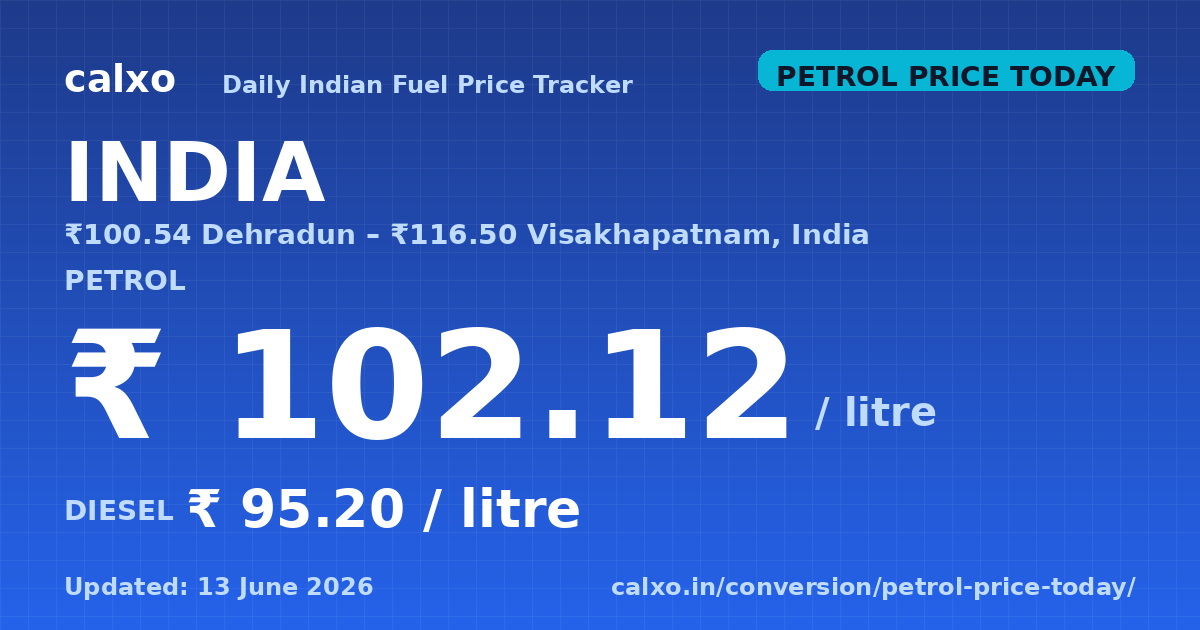
Petrol prices in India change every day at 6:00 AM. Oil marketing companies (Indian Oil, BPCL, HPCL) revise rates based on international crude prices, the rupee-dollar exchange rate, and state-level taxes. The price you see at the pump is rarely just the base fuel cost — taxes make up 50-60% of what you actually pay.
Why petrol prices differ so much city to city
Someone paying ₹94.77/litre in Delhi and someone paying ₹109.47/litre in Visakhapatnam are buying the same fuel from the same refineries. The difference is entirely taxes.
Every litre of petrol has three layers of tax sitting on top of the base price:
- Central excise duty — fixed at ₹19.90/litre for petrol, same across India
- State VAT — this is the big variable. Ranges from ~14% (Gujarat) to ~36% (Maharashtra, Rajasthan, Telangana)
- Dealer commission — ₹3.8–4.5/litre depending on the city
Gujarat and Delhi charge lower VAT, which is why Ahmedabad (₹93.08) and Delhi (₹94.77) are consistently among the cheapest metros. Rajasthan, Maharashtra, and southern states charge higher VAT — hence Hyderabad, Mumbai, and Thiruvananthapuram cross ₹103-107.
How the daily price revision works
Indian Oil, BPCL, and HPCL follow a dynamic pricing model called the Daily Price Revision (DPR) system, introduced in 2017. Every morning at 6 AM, they update pump prices based on:
- 15-day rolling average of crude oil (Brent) — not the spot price. This smooths out single-day spikes.
- INR/USD exchange rate — India imports ~85% of its crude. A weaker rupee directly pushes prices up.
- Freight and refinery margins — minor but included in the formula
In practice, prices stay flat for weeks at a time unless crude moves sharply. The revision that made news in May 2022 (₹10/litre hike overnight) was an exception, not the norm.
Petrol vs diesel: why the gap exists
Diesel is ₹6-8/litre cheaper than petrol in most cities. This gap is structural — diesel carries lower central excise duty (₹15.80/litre vs ₹19.90 for petrol) and most states also apply lower VAT on diesel because it’s classified as an “essential commodity” used by trucks, buses, and agriculture.
The flip side: diesel cars cost ₹80,000-1,50,000 more upfront. The breakeven on that premium at current price differentials requires roughly 80,000-1,00,000 km of driving, which is why diesel makes sense only for high-mileage drivers.
What the price at the pump actually breaks down to
For Delhi petrol at ₹94.77/litre:
| Component | Amount |
|---|---|
| Base price (ex-refinery) | ~₹55.00 |
| Central excise duty | ₹19.90 |
| Delhi VAT (19.4% on base+excise) | ~₹14.47 |
| Dealer commission | ₹3.87 |
| Freight & other charges | ~₹1.53 |
| Total at pump | ₹94.77 |
Taxes alone are ₹34+ per litre — about 36% of what you pay. In Maharashtra, the VAT portion alone is ₹26-28/litre, which is why Mumbai and Pune prices are ₹8-10 higher than Delhi for identical crude costs.
Frequently asked questions
Why didn’t the price change today even though crude oil moved?
The revision uses a 15-day rolling average, so a single day’s crude movement doesn’t immediately show up at the pump. Sustained moves over 2-3 weeks are what eventually trigger a revision.
How do I check the exact price at my nearest pump?
Indian Oil’s official app (IndianOil One) shows live pump-wise prices. BPCL and HPCL have similar apps. The prices in the calculator above are city averages — actual pump prices may vary by ₹0.10-0.50 within a city based on the dealer’s exact location.
Does CNG make more sense than petrol right now?
At current rates, CNG runs at roughly ₹55-65 per kg equivalent in most cities versus ₹95-109/litre for petrol. On a km/cost basis, CNG is 40-50% cheaper. The catch: CNG infrastructure is concentrated in NCR, Mumbai, Ahmedabad, Pune — outside these cities, range anxiety on a CNG car is real.
Will petrol prices go down in 2026?
That depends on Brent crude staying below $80/barrel and the rupee not weakening significantly. As of April 2026, crude is around $73-75/barrel, which is why prices are relatively stable. A monsoon-driven INR weakening (as happened in Q3 2023) or any Middle East supply disruption could push prices up ₹3-5/litre quickly.
Sources
- Indian Oil Corporation: daily price revision data
- Petroleum Planning and Analysis Cell (PPAC), Ministry of Petroleum
- State commercial tax department notifications for VAT rates